
-
Admissions & Finance
- Academic Programmes
- Transfer Pathways
- Student Resources
-
About Us
-

Bermuda College Commencement Ceremonies
Join us for one of our three commencement ceremonies honoring our 2026 Graduates!
-
REGULATION IS IN BERMUDA AND IT’S HERE TO STAY!
Capitalise on these New Online Compliance Training Opportunities offered through Bermuda College*
Bermuda Compliance Academy in association with Association of Bermuda Compliance Officers
Whether you're just starting out or building on years of experience, this is your opportunity to gain Bermuda-specific, real-world compliance skills that translate across industries. Led by local experts and industry practitioners, sessions cover the essential fundamentals and emerging issues within the compliance field including:
- Fundamentals of a compliance program
- Onboarding and ongoing monitoring
- Developing robust Risk Assessments & Risk Policy frameworks
- Corporate Governance
- AML/ATF Audit Readiness
- Privacy & Data Protection
- Managing Investigations
- Effective sanctions and transaction monitoring
- Preparing for onsite inspections
- Navigating the international AML/ATF/CPF regulatory landscape (FATF/CFATF updates)
Sessions blend practical tools with local context, equipping participants with skills they can apply immediately.
Governance (TDS 480)
An insightful workshop series that covers the relationship between Governance, Risk and Compliance to achieve effectiveness in operational and compliance outcomes.
- GRC: Building Systems for Resilience & Effectiveness.
- Corporate Governance: Principles for Effectiveness in Compliance.
- Introduction to Directorship: Risk and Requirements to act as a Director to a Corporate Structure
- Compliance Reconfigured: Updating HR Policies to Integrate AML Compliance
- ESG: Considerations for Financial Services Professionals
Spring Dates
| Section | Day | Time | Dates | price |
| SEC A1 | Wednesday | 6 - 8PM | January 21 - February 18 | $395 |
Corporate Governance & AI Governance (TDS 481)
A four-week professional training programme providing a structured understanding of corporate governance principles and emerging AI governance frameworks.
Learning Objectives
- Understand core principles and theories of corporate governance.
- Evaluate board effectiveness and risk oversight structures.
- Assess regulatory expectations and emerging governance trends.
- Identify AI-related risks and implement basic AI governance frameworks
Weekly Topics
- Week One: Foundations of Corporate Governance
- Week Two: Board effectiveness, Risk & Accountability
- Week Three: Regulatory Governance & Digital Oversight
- Week Four: AI Governance & Responsible Innovation
Spring Dates
| Section | Day | Time | Dates | price |
| SEC A1 | Wednesday | 6 - 8PM | April 15 - May 6 | $395 |
KIXKO FOR BEGINNERS
Anti Money Laundering/Countering Terrorist Financing Certificate
An ideal first step for career seekers/changers. Short, introductory courses in modular format. Short multiple choice e-test at end of each module.
REQUIREMENTS: High school graduation/GED diploma
ACAMS
FOR THOSE WITH EXPERIENCE IN COMPLIANCE
Association of Certified Anti-Money Laundering Specialists (ACAMS)
Advanced certification for anti-money laundering/counter terrorism financing.
Internationally recognised. ACAMS examination of multiple choice questions.
REQUIREMENTS
Undergraduate/graduate degree or equivalent, professional experience in the anti-money laundering field or credentials (ACCA, CPA,LLB, etc.), plus three professional references.
CAREER FIELDS
Compliance officers, auditors, audit managers, business control analysts/managers, financial crimes compliance analysts, operations managers, regulatory control analysts, sanctions analysts.
FOR THOSE WITH EXPERIENCE IN ALL LEVELS OF COMPLIANCE
Certificates Various levels available – from introductory to advanced
Registration deadline to be determined
Various levels of qualifications available. Assessment ranges from on-line multiple choice exam to 2500-word essay assignments.
REQUIREMENTS
Minimum – high school diploma. Higher levels require undergraduate degree/professional experience in corporate business, legal or finance environments. ICA membership is compulsory.
CAREER FIELDS
Internal and external audit staff, staff working in risk functions, analysts/officers, regulatory representatives, compliance employees, compliance managers/directors for business/legal institutions.
*PROVIDED THROUGH BERMUDA COLLEGE DIVISION OF PROFESSIONAL AND CAREER EDUCATION
Students are strongly urged to attend the information sessions to have direct access to compliance professionals, and overseas programme reps. Dedicated time for FAQs will also be provided.
For more information, please contact Programme Coordinator, Carleen Place
Artificial Intelligence Foundations Course
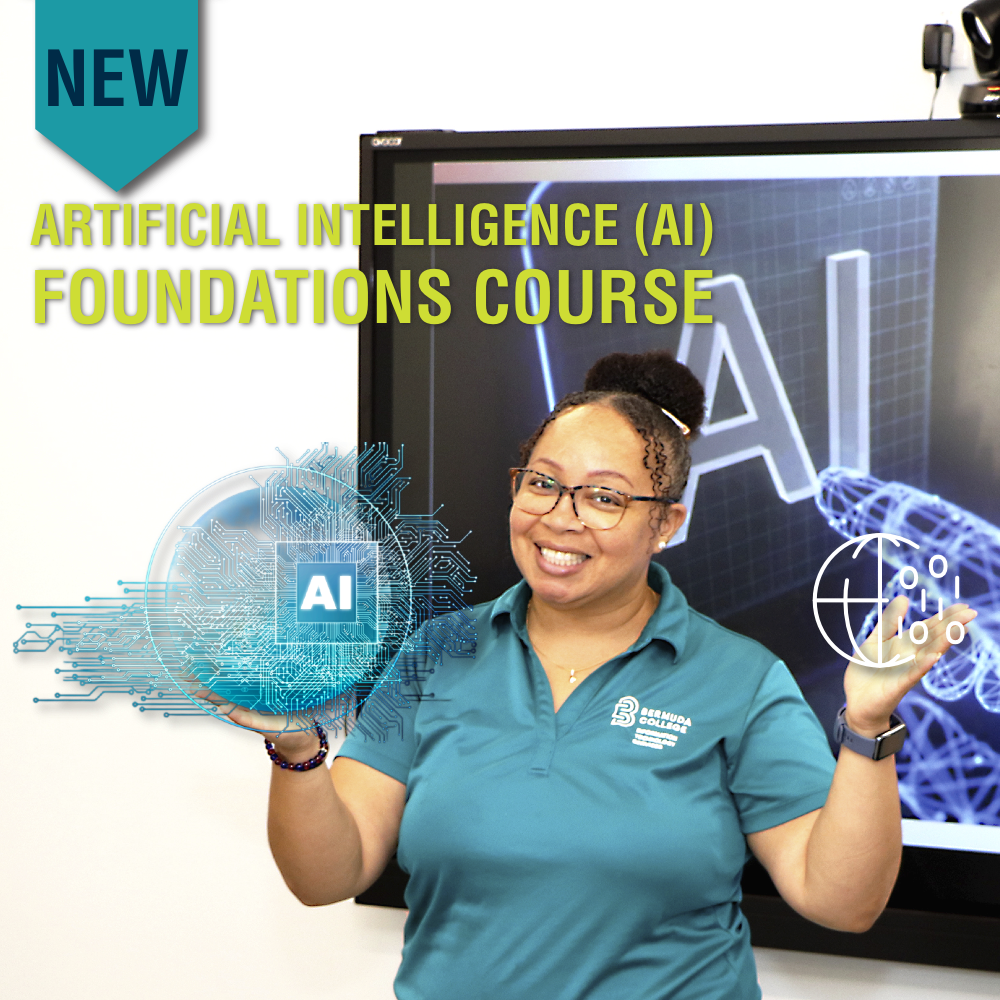
Partnering with Bermuda Clarity Institute The Generative AI Foundations Course will give you the tools to harness the power of this amazing new technology.
In this in person course, you will take away a practical strategy and techniques for implementing a generative AI strategy for your organization or business. Learn the top five considerations when starting with generative AI as well as tips to manage AI-driven projects. Discover how to leverage popular generative AI platforms for your business needs. Discuss the top tools to use to manage your generative AI projects and build integration into your existing workflows. See how generative AI tools work and how to use them to further your business goals. See what trends are on the horizon and where your goals fit with those new trends. Hear about applications of generative AI in various industries and how companies are using AI to enhance their operations. Discuss how business processes can change with AI integration and get feedback on cutting edge AI strategy while discovering best practices for user experience and ethical considerations. Learn how to manage the influx of data and outputs created by generative AI. Develop a manageable workflow and get productivity tips to be more efficient.
| Course code: TDS 1240 | SECA1 |
| The course content can be accessed from | February 5, 2026 |
| End of Course | March 5, 2026 |
| Time & Day | 6PM - 9PM (Thursday) |
| Price | $795 |
Advanced Generative AI and Prompt Engineering for Industry Applications TDS 1245
Take your knowledge of generative AI to the next level with this advanced course designed for professionals seeking to specialize in AI-driven solutions across industries. Building on foundational skills, this course will focus on advanced prompt engineering, workflow automation, and the customization of AI models for specific business needs. You’ll gain hands-on experience with both ChatGPT and Microsoft Copilot, learning how to leverage the strengths of each tool to optimize business processes, generate insights, and create tailored AI applications.
Throughout five weeks of in-depth sessions, you’ll explore how to refine prompts for precision, integrate generative AI models into existing workflows via APIs, and automate complex business functions with Copilot. You will also delve into data analysis techniques, develop custom AI models, and address ethical considerations such as bias and data privacy.
This course culminates in a final project where you’ll design an AI solution tailored to a specific industry, which you will pitch and present in the last session. Graduates will leave with a strong portfolio of work, demonstrating advanced skills in AI implementation and strategic AI project management, making them highly competitive in this rapidly evolving field.
| Course code: TDS 1245 | SECA1 |
| The course content can be accessed from | TBD |
| End of Course | TBD |
| Time & Day | 6PM - 9PM (Tuesday) |
| Price | $895 |
Funding Support
Funding support for Spring 2026 is available until February 27, 2026 at 5PM. Fill out the Funding Support application here.
Application & Registration Process
Complete the Bermuda College APACE Application form and email to
For further information please contact 236-9000 x4117 or
CPA Chartered Professional Accountant (Canada)
Programme Overview
The new Chartered Professional Accountant (CPA) designation demonstrates leadership, inspires confidence, and commands respect, while reaffirming the reputation and influence of Canada’s accounting profession in the global financial community.
CPA Prerequisite Education Programme (CPA PREP)
If your baccalaureate degree does not include the necessary subject area coverage, you will be able to meet requirements through the individual modules in the new (CPA PREP). Delivered on a part-time basis; the modularized programme requires that students complete only those modules that they require.
Modules include:
- Introductory Financial Accounting
- Introductory Management Accounting
- Economics
- Statistics
- Inter. /Adv. Financial Accounting
- Corporate Finance
- Audit and Assurance
- Tax
- Inter. /Adv. Management Accounting
- Strategy and Governance
- Business Law
- Information Technology
For more information
www.cpabermuda.bm for details or contact Ms. Amy Burridge, CPA Student Recruitment Advisor.
Association of Chartered Certified Accountant
ACCA Programme Overview
ACCA has more paths to success than anyone else. Start at the right level for you, and begin your ACCA journey today.
Please email This email address is being protected from spambots. You need JavaScript enabled to view it. to book your computer-based exam session. Exams are held at the Bermuda College Testing Centre.
Spring 2026 Course Schedule
Recording Financial Transactions (FA1)
$895
This course develops a knowledge and understanding of the operational aspects of maintaining accounting records and procedures relating to invoicing, receipts and payments, recording income and expenditure, the preparation of ledger accounts and the preparation of an initial trial balance.
| Course code: TDS ACCA10 | SECA1 - (H211) - 6:00 - 9:00PM |
| Start of Course | January 27, 2026 |
| End of Course | April 28, 2026 |
Management Information (MA1)
$895
This course develops knowledge and an understanding of how organisations provide basic management information for decision-making, planning and control.
Co-requisite: TDS ACCA10
Note: Both courses are required for completion of the RFQ Level 2. It is highly recommended that students take both FA1 and MA1 during the same semester.
| Course code: TDS ACCA12 | SECA1 - (H102) - 6:00 - 9:00PM |
| Start of Course | January 29, 2026 |
| End of Course | April 30, 2026 |
Diploma in Financial and Management Accounting (RQF Level 3)
Maintaining Financial Records (FA2)
$895
This course will develop your knowledge and understanding of the techniques used to maintain accounting records and prepare final accounts of unincorporated entities.
| Course code: TDS ACCA20 | SECA1 - (H213) - 6:00 - 9:00PM |
| Start of Course | January 26, 2026 |
| End of Course | April 27, 2025 |
Managing Cost and Finance (MA2)
$895
This course will develop your knowledge and understanding of the principles and techniques used in recording, analysing and reporting costs and revenues for internal management purposes. To demonstrate and develop applicable cost concepts in making short-term decisions, and the application of spreadsheets in management accounting.
NOTE: Both courses are required for completion of the Diploma in Financial and Management Accounting (RQF Level 3). It is highly recommended that students take both FA2 and MA2 during the same semester.
| Course code: TDS ACCA22 | SECA1 - (H102) - 6:00 - 9:00PM |
| Start of Course | January 27, 2026 |
| End of Course | April 28, 2025 |
Diploma in Accounting and Business (RQF Level 4)
Business and Technology (BT)
$895
This module will develop knowledge and understanding of the basic principles of effective management, the business environment and its influence on the operation, the role of the accountant and other key business functions which contribute to an efficient, effective and ethical organisation.
| Course code: TDS ACCA30 | SECA1 - (G228) - 6:00 - 9:00PM |
| Start of Course | January 27, 2026 |
| End of Course | April 28, 2026 |
Financial Accounting (FFA)
$895
This course will develop your knowledge and understanding of the underlying principles and concepts relating to financial accounting and technical proficiency in the use of double-entry accounting techniques, including the preparation of basic financial statements.
*Prerequisite/co-requisites TDS ACCA30 and TDS ACCA32
| Course code: TDS ACCA34 | SECA1 - (G228) - 6:00 - 9:00PM |
| Start of Course | January 26, 2026 |
| End of Course | April 27, 2026 |
ACCA Qualification
Performance Management (F5/PM)
$1,195
This course is designed to develop knowledge and skills in the application of management accounting techniques to quantitative and qualitative information for planning, decision-making, performance evaluation and control.
| Course code: TDS ACCA40 | SECA1 - (H275) - 6:00 - 9:00PM |
| Start of Course | January 29, 2026 |
| End of Course | April 30, 2026 |
Taxation (F6/TX)
$1,195
This course will develop knowledge and skills relating to the tax system as applicable to individuals, single companies, and groups of companies.
| Course code: TDS ACCA42 | SECA1 - (G304) - 6:00 - 9:00PM |
| Start of Course | January 28, 2026 |
| End of Course | April 29, 2026 |
Financial Reporting (F7/FR)
$1,195
The course is designed to develop knowledge and understanding of International Financial Reporting Standards (IFRS). Students will also learn how to apply these standards and the concepts and principles which underpin them.
| Course code: TDS ACCA44 | SECA1 - (G304) - 6:00 - 9:00PM |
| Start of Course | January 28, 2026 |
| End of Course | April 29, 2026 |
Audit and Assurance (F8/AA)
$1,195
This course will develop knowledge and skills in the process of carrying out the assurance engagement and its application in the context of the professional regulatory framework.
| Course code: TDS ACCA46 | SECA1 - (G323) - 6:00 - 9:00PM |
| Start of Course | January 28, 2026 |
| End of Course | April 29, 2026 |
Foundations in Accountancy
ACCA's Foundations in Accountancy is an entry-level suite of awards, including diplomas and a Certified Accounting Technician (CAT) Qualification.
There are four foundation awards available:
- ACCA Diploma in Financial and Management Accounting (RQF Level 2)
- ACCA Diploma in Financial and Management Accounting (RQF Level 3)
- ACCA Diploma in Accounting and Business (RQF Level 4)
- Certified Accounting Technician
If you don’t have the relevant qualifications to start the ACCA Qualification, then our Foundations exams will prepare you. They provide an exceptional introduction to the finance sector and teach some essential skills and techniques that will allow you to hit the ground running in your career.
High school graduates, mature students and working professionals with no formal academic qualification can undertake any course* within Foundations in Accountancy.
ACCA Foundations exams are designed for those who don’t have any relevant qualifications. However, you may benefit from taking their self-check module that lets you test your English and maths skills. It’s optional and entirely anonymous.
Introductory, Intermediate and Diploma
Applied Knowledge and Applied Skills
The Applied Knowledge, Applied Skills and Strategic Professional exams together form the ACCA Qualification. If you don’t have the relevant education to jump straight in with the Strategic Professional exams then you can start at Applied Knowledge. However, you’ll need to have some relevant secondary education.
The Applied Knowledge and Applied Skills exams provide you with the essential building blocks needed for a successful career in Finance and Accountancy.
Applied Knowledge
The Applied Knowledge exams are an exceptional introduction to the world of finance and accounting, providing you with a broad understanding of essential accounting techniques.
There are three Applied Knowledge exams:
- Accountant in Business
- Management Accounting
- Financial Accounting
To start studying for the Applied Knowledge exams you must be qualified to University-entrance level. And once you’ve completed these three exams you’ll be awarded the ACCA Diploma in Accounting and Business (RQF Level 4) and be eligible to start the Applied Skills exams.
Applied Skills
The Applied Skills exams build on your existing knowledge and understanding developing strong, broad and practical finance skills.
There are six Applied Skills exams:
- Corporate and Business Law
- Performance Management
- Taxation
- Financial Reporting
- Audit and Assurance
- Financial Management
To start studying for the Applied Skills exams you must have either completed the Applied Knowledge exams, have achieved the ACCA Diploma in Accounting and Business (RQF Level 4) or have a relevant accounting or finance qualification at degree level.
Once you’ve completed the Applied Skills exams you can move on to the Strategic Professional exams.
Strategic Professional
Complete the final step of the ACCA Qualification with the Strategic Professional exams and you’ll be on your way to adding ACCA after your name.
Learn the dynamic skills and strategic vision that all great businesses and financial leaders need. The Strategic Professional exams also give you the opportunity to specialise in areas that best suit your career ambitions.
The Strategic Professional level requires you to undertake:
- 4 exams: This includes two compulsory modules which include Strategic Business Leader and Strategic Business Reporting. You then need to choose two further courses that suit your career ambitions from Advanced Financial Management; Advanced Performance Management; Advanced Taxation; or Advanced Audit and Assurance.
To become an ACCA member you’ll also need to complete: - 1 ethics and professional skills module: We believe that finance professionals should be ethical and demonstrate the professional skills to make an impact immediately. This is why you’ll do an Ethics and Professional Skills module.
- 3 years’ work experience: in a relevant workplace role.
To complete the ACCA Qualification and become an ACCA member, you need to complete the Applied Knowledge, Applied Skills and Strategic Professional exams. However, your previous education may qualify you for some exam exemptions, such as having a relevant degree from an ACCA-accredited university. If your previous qualifications exempt, you from all the Applied Knowledge and Applied Skills exams then you can start your studies at Strategic Professional. Otherwise, you’ll need to start at either Applied Knowledge or Applied Skills.
EXEMPTIONS:
*To find out what exemptions you may qualify for use the tuition calculator below.
Exam Fees
Foundations Courses:
Bermuda College Student - $200 per exam
General Public - $200 per exam
Applied Knowledge & Applied Skills Courses:
Bermuda College Student - $200 per exam
General Public - $250 per exam
Associate of Science Programmes
View Associate of Science Programmes
Associate Degrees provide the first two years of College that can be transferred to overseas universities or used to go directly into the workforce.
Associate of Science
The Sciences – which include the natural sciences of biology, earth and environmental science, chemistry and physics – provide the foundation for a variety of careers including medicine, nursing, veterinary medicine, lab technology, environmental health, conservation, education and nutrition.
While the first year of this programme includes courses from the arts as well as the sciences, in the second year, students will have the opportunity to concentrate in biology, chemistry, earth and environmental science, or physics.
This two-year degree is designed for students who want to transfer abroad to obtain baccalaureate degrees in the science disciplines.
Programme Details
CURRICULUM TOTAL CREDITS: 64-70
Year 1
First semester - 15 credits
CSC 1110 Learning Strategies for Student Success 1
ENG 1111 Freshman Composition 3
MAT 1105 College Algebra 3
ELECTIVE Natural Sciences (1100-level) 2 electives in BIO, CHM, EES or PHY 8
Second semester - 18 credits
ENG 1112 Literary Analysis 3
MAT 1141 Pre-Calculus 3
Natural Sciences (1100-level) 2 courses in BIO, CHM, EES or PHY 8
Natural Sciences (1100-level) 1 course of your choice.* 4
Year 2
First semester - 18 credits
MAT 1152 or Calculus I
MAT 2233 Statistics I 3
Natural Sciences (2000-level) 2 course in area of concentration** 8
Natural Sciences (2000-level) 1 course of your choice 4
Humanities (1100 or higher) 3
Second semester - 17-19 credits
Natural Sciences (2000-level) 1 course in area of concentration 4
Natural Sciences (2000-level) 1 course of your choice (not in your area of concentration) 4
Elective (1100 or higher) 1 course of your choice.*** 3 or 4
Elective (2000) 1 course of your choice.*** 3 or 4
Social Science (1100 or higher) 3
*EES as an area of concentration is not recommended for students intending to enter into health professions.
**See the notes for area of concentration
***Prerequisites must be met for all courses.
Course Concentrations
CONCENTRATIONS AND SUBJECTS OF STUDY
NOTE: Candidates should note that the approved courses indicated under each of the following subjects of study are those described under the heading COURSE DESCRIPTIONS: Associate Degree Courses.
These courses will earn general and elective credits in an associate degree programme, unless otherwise specified.
ACCOUNTING
Approved Courses: all coded ACC.
Concentration in the Associate in Business Administration:
ACC 1135, ACC 1145, ACC 2201, ACC 2202, ACC 2253, ACC 2254.
ART HISTORY
Approved Courses: all coded AHS.
Concentration in the Associate in Arts:
AHS 1126 and AHS 1127, 12 credits in AHS at the 2000-level.
BIOLOGY
Approved Courses: all coded BIO.
Note exclusions in the course descriptions.
Concentration in the Associate in Science:
BIO 1121, BIO 1122, and 3 BIO courses at the 2000-level.
CHEMISTRY
Approved Courses: all coded CHM.
Note exclusions in the course descriptions.
Concentration in the Associate in Science:
CHM 1111, CHM 1112, and 3 CHM courses at the 2000-level.
EARTH & ENVIRONMENTAL STUDIES
Approved Courses: all coded EES.
Note exclusion in the course descriptions.
Environmental Science Concentration in the Associate in Science:
EES 1101, 3 credits from EES 1102 - 1105 ; BIO 1121, BIO 1122, 6 credits from EES 2211, EES 2298 (not more than 3 credits from EES 2298), CHM at the 2000-level.
ENGLISH
Approved Courses: all coded ENG.
Concentration in the Associate in Arts:
6 credits in ENG 1111 and ENG 1112, 12 credits in ENG at the 2000-level.
FINE ART
Approved Courses: all coded ART.
MANAGEMENT
Approved Courses: all coded MGN.
Concentration in the Associate in Business Administration:
MGN 1114, MGN 2217, 12 credits at the 2000-level from amongst MGN 2110. MGN 2210, MGN 2211, MGN 2222, MGN 2230, MGN 2240, MGN 2241, MGN 2245, MGN 2250 and MGN 2298.
MATHEMATICS
Approved Courses: all coded MAT.
Note exclusions in the course descriptions.
Concentration in the Associate in Arts:
MAT 1141, MAT 1152, 12 credits in MAT at the 2000-level (excluding MAT 2233 and MAT 2234).
PSYCHOLOGY
Approved Courses: all coded PSY.
Note exclusions in the course descriptions.
Concentration in the Associate in Arts:
PSY 1101, PSY 1102, SSC 2200, 9 credits in PSY at the 2000-level.
SOCIOLOGY
Approved Courses: all coded SOC.
Concentration in the Associate in Arts:
SOC 1101, SOC 1102, SSC 2200, 9 credits in SOC at the 2000-level.
NOTE ON PREPARATION FOR PROFESSIONAL PROGRAMMES
Certain overseas professional associations and institutes recognise certain Bermuda College courses in the areas of accounting and business administration and grant exemptions from courses in their own professional training programmes. Students are advised to contact the organisation.
Humanities, Social Sciences and Natural Science Options
Humanities
- Art and Design
- Art History
- Education
- Film
- French
- History
- Music
- Philosophy
- Spanish
- Religious Studies
- English Literature at 2000 level
Social Sciences
- Economics
- Political Science
- Psychology
- Sociology
- Social Work;
- Earth & Environmental Studies at 2000 level
Natural Sciences
- Biology
- Chemistry
- Earth & Environmental Studies
- Physics
Credit Course Descriptions
Associate of Science (Actuarial Science)
Actuarial science, in the insurance and reinsurance industries, is the practice of using statistical information to determine rates and rating methods, and evaluating insurance company reserves. Actuaries, particularly Bermudian actuaries, are very much in demand in Bermuda’s insurance and reinsurance industries.
Bermuda College, with the support of Chubb and the Chubb Foundation, has developed this programme for students wishing to enter the actuarial field. The programme provides a solid foundation for further study abroad in
preparation for the rigorous series of examinations that lead to membership in the profession. The programme has a strong mathematical base, and includes an introductory course in Actuarial Science.
Students wishing to complete this degree in two years should expect to take MAT 1105/MAT 1141 during the summer prior to their freshman year.
Since the requirements of four-year institutions vary widely, it is essential that the programme outlined in the catalogue of the student’s college of choice, be followed as closely as possible.
Programme Details
CURRICULUM TOTAL CREDITS: 64
Year 1
First semester – 16 credits
CSC 1110 Learning Strategies for Student Success (1 Credit)
CIS 1125 Introduction to Computers and Information Technology (3 Credits)
ECO 1101 Principles of Microeconomics (3 Credits)
ENG 1111 Freshman Composition (3 Credits)
MAT 1141 Pre-Calculus (3 Credits)
Humanities (1100 or higher) course of your choice.* (3 Credits)
Second semester – 15 credits
ACC 1135 Accounting I (3 Credits)
CIS 1130 Data Management (3 Credits)
ECO 1102 Principles of Macroeconomics (3 Credits)
ENG 1112 or Literary Analysis or
ENG 1115 Writing for Professionals (3 Credits)
MAT 1152 Calculus I (3 Credits)
Year 2
First semester – 15 credits
Accounting, Mathematics, Management, Computer Information Systems, Insurance or
Law course of your choice.*† (3 Credits)
Accounting, Mathematics, Management, Computer Information Systems, Insurance or
Law course of your choice.*† (3 Credits)
MAT 2201 Calculus II (3 Credits)
MAT 2210 Linear Algebra (3 Credits)
MAT 2233 Statistics I (3 Credits)
Second semester – 18 credits
ASC 1101 Introduction to Actuarial Science (3 Credits)
Accounting, Mathematics, Management, Computer Information Systems, Insurance or
Law course of your choice.*† (3 Credits)
Accounting, Mathematics, Management, Computer Information Systems, Insurance or
Law course of your choice.*† (3 Credits)
MAT 2240 Elementary Differential Equations (3 Credits)
MAT 2220 Multivariable Calculus (3 Credits)
MAT 2234 Statistics II (3 Credits)
*Before one can be enrolled in any course one must satisfy the prerequisites.
†CIS 1120 cannot be used to fulfil this requirement.
Humanities, Social Sciences and Natural Science Options
Humanities
- Art and Design
- Art History
- Education
- Film
- French
- History
- Music
- Philosophy
- Spanish
- Religious Studies
- English Literature at 2000 level
Social Sciences
- Economics
- Political Science
- Psychology
- Sociology
- Social Work;
- Earth & Environmental Studies at 2000 level
Natural Sciences
- Biology
- Chemistry
- Earth & Environmental Studies
- Physics
Credit Course Descriptions
Associate of Science (Computer Information Systems)
Computer technology is updated and improved upon on a daily, even hourly, basis in the 21st century. Bermuda College’s Associate of Science (Computer Information Systems) is reviewed regularly to incorporate the changes and updates in the technology field. IT specialisation and e-commerce courses have been added to the core curriculum. Further, the programme’s curriculum equips students with the same level of competency as demonstrated by the internationally recognised certifications of A+, Network+, iNet+, CCNA, GIAC/GSEC, MCP and MOUS.
The foundation of the programme is the study of computer applications in the business environment. It also includes a mandatory internship between the first and second years of study, providing hands-on experience in
local and international companies.
Programme Details
CURRICULUM TOTAL CREDITS: 64-66
Year 1
First semester - 16 credits
CSC 1110 Learning Strategies for Student Success (1 Credits)
ENG 1111 Freshman Composition (3 Credits)
MAT 1105 or College Algebra or
MAT 1131 Finite Mathematics (3 Credits)
CIS 1120 Introduction to Business Applications of Computers (3 Credits)
CIS 1125 Introduction to Computer & Information Technology (3 Credits)
ECM 1110 Generating Web Pages (3 Credits)
Second semester - 15 credits
ENG 1112 Literary Analysis or
ENG 1115 Writing for Professionals (3 Credits)
ACC 1135 Introduction to Accounting Or MGN 1114 Introduction to Business (3 Credits) MAT 1141 Pre-Calculus or
MAT 2233 Statistics I (3 Credits)
CIS 1130 Data Management (3 Credits)
CIS 2278 Microcomputer Hardware and Software (3 Credits)
CIS 1180 Computer information systems internship (3 Credits)
Year 2
First semester - 15-16 credits
Elective Humanities or Natural Science or Social Science (3 or 4 Credits)
MAT 1152 Calculus I or
MAT 2234 Statistics II or
MAT 1132 Business Calculus (3 Credits)
CIS 1155 Programming for Information System I (3 Credits)
CIS 2231 System Analysis and Design (3 Credits)
CIS 2290 Networking Technologies (3 Credits)
Second semester - 15-16 credits
Elective Humanities or Natural Science or Social Science (3 or 4 Credits)
MGN 2230 Introduction to Project Management (3 Credits)
CIS 2255 Programming for Information Systems II (3 Credits)
CIS 2297 Security Fundamentals and Policies (3 Credits)
CIS 2295 Operating Systems & Infrastructure (3 Credits)
*Before one can be enrolled in any course one must satisfy the prerequisites.
Humanities, Social Sciences and Natural Science Options
Humanities
- Art and Design
- Art History
- Education
- Film
- French
- History
- Music
- Philosophy
- Spanish
- French
- Religious Studies
- English Literature at 2000 level
Social Sciences
- Economics
- Political Science
- Psychology
- Sociology
- Social Work;
- Earth & Environmental Studies at 2000 level
Natural Sciences
- Biology
- Chemistry
- Earth & Environmental Studies
- Physics
Credit Course Descriptions
Associate of Science (Education)
This programme is intended for students wishing to pursue a baccalaureate degree in elementary, middle or senior-level education at a recognised teacher education institution.
The programme features a common liberal arts core that spans the humanities, mathematics, social sciences, and natural sciences disciplines. In the second year of the programme, the core courses are supplemented with courses in the foundations of education, in human growth and development, and in the application of psychological principles to the teaching profession. In addition through the twelve elective credits, students intending to teach at the senior level are able to complete a concentration in one of the disciplines noted above.
As the programme includes opportunities for observations in private and public educational settings, students must submit the following:
- SCARS Certification
- Police Record Check
- Proof of Health Insurance
- Completed Medical Form
- Completed Ministry of Education
- Staff in Confidence Form
Programme Details
CURRICULUM TOTAL CREDITS: 61- 63
Year 1
First semester - 16-17 credits
CSC 1110 Learning Strategies for Student Success 1
ENG 1111 Freshman Composition 3
HIS 1140 World History I or
HIS 1141 World History II 3
Mathematics (1100-level) course of your choice.* 3
Natural Sciences (1100-level) course of your choice.* 3 or 4
PSY 1101 Introduction to Psychology I 3
Second semester - 15-16 credits
ENG 1112 Literary Analysis 3
Elective Course of your choice** 3
MAT 2233 Statistics I 3
Natural Sciences (1100-level) course of your choice.* 3 or 4
PSY 1102 Introduction to Psychology II 3
Year 2
First semester - 15 credits
EDU 2201 Foundations of Education 3
ENG 2212 Oral Communication 3
Elective Course of your choice** 3
Elective Course of your choice** 3
PSY 2270 Learning Theory 3
Second semester - 15 credits
EDU 2202 Children and Their Environment 3
EDU 2251 Classroom Management 3
Elective Course of your choice* 3
PSY 2272 Educational Psychology 3
PSY 2240 Human Development 3
*Before one can be enrolled in any course one must satisfy the prerequisites.
**Students intending to teach at the elementary school level are recommended to take Music 1103
Humanities, Social Sciences and Natural Science Options
Humanities
- Art and Design
- Art History
- Education
- Film
- French
- History
- Music
- Philosophy
- Spanish
- Religious Studies
- English Literature at 2000 level
Social Sciences
- Economics
- Political Science
- Psychology
- Sociology
- Social Work;
- Earth & Environmental Studies at 2000 level
Natural Sciences
- Biology
- Chemistry
- Earth & Environmental Studies
- Physics
Credit Course Descriptions
Associate of Science (Marine Science)
Marine Science is an interdisciplinary field, and therefore requires training in many of the basic sciences. The Marine Science Programme is designed to prepare a student for entrance into this field or industry.
Programme Details
CURRICULUM TOTAL CREDITS: 78-80
Year 1
SUMMER SESSION - 4 credits
BIO 1121 Principles of Biology I 4
First semester – 16 credits
CSC 1100 Learning Strategies for Student Success 1
ENG 1111 Freshman Composition 3
MAT 1105 College Algebra 3
CHM 1111 Principles Chemistry I 4
BIO 1122 Principles of Biology II 4
Elective Humanities (1100 level) elective 3
Second Semester - 18 credits
ENG 1112 Literary Analysis 3
MAT 1141 Pre-Calculus 3
CHM 1112 Principles of Chemistry II 4
PHY 1121 Principles of Physics 4
EES 1105 Introduction to Oceanography 4
SUMMER SESSION - 7-8 credits
NSC 2200 Research Diving Methods 4
Elective Natural Science elective 3 – 4
Year 2
First Semester - 25-26 credits
MAT 2233 Statistics I 3
Stream I 23 credits
EES 1101 Environmental Science 4
EES 2211 Environmental Geography 3
Environmental Science course (2000-level) 4
Environmental Science course (2000-level) 4
Biology course (2000-level) 4
Biology course (2000-level) 4
Stream II 22–23 credits
CHM 2256 Organic Chemistry I 4
CHM 2257 Organic Chemistry II 4
BIO 2210 Cellular Biology 4
Chemistry course (2000-level) 4
Chemistry course (2000-level) 3 or 4
Computer Science Elective 3
Stream III 23 credits
BIO 2210 Cellular Biology 4
Biology course (2000-level) 4
Biology course (2000-level) 4
Chemistry course (2000-level) 4
Biology course (2000-level) 4
Computer Science Elective 3
Second Semester - 6 credits
MAT 2234 Statistics II 3
Elective Social Sciences elective 3
SUMMER SESSION - 8 credits
Internship (Honours degree student) 4
Elective Natural Sciences (2000-level) elective 4
*Before one can be enrolled in any course one must satisfy the prerequisites.
Humanities, Social Sciences and Natural Science Options
Humanities
- Art and Design
- Art History
- Education
- Film
- French
- History
- Music
- Philosophy
- Spanish
- Religious Studies
- English Literature at 2000 level
Social Sciences
- Economics
- Political Science
- Psychology
- Sociology
- Social Work;
- Earth & Environmental Studies at 2000 level
Natural Sciences
- Biology
- Chemistry
- Earth & Environmental Studies
- Physics
Credit Course Descriptions
Associate of Science (Nursing)
The Associate of Science in Nursing will deliver quality, innovative, nursing education, and typify excellence in nursing practice. It has been developed and endorsed in collaboration with the Ministry of Health, the Bermuda Hospitals Board, and other key stakeholders in nursing throughout the Island. The curriculum was developed utilising the American Nurses Association standards and the Accreditation Commission for Education in Nursing (ACEN) standards. It integrates a strong liberal arts core, and a nursing core alongside sound clinical practice, ensuring graduates receive superior instruction and deliver high quality care, along with critical palliative skills that respect the dignity of all patients.
The programme includes clinical opportunities both locally and overseas, hence students must commit to travelling to obtain clinical exposure with key clinical partners overseas. Students must possess the appropriate travel documents and identification required for the overseas clinical experience.
Students will be admitted into the first nursing course Introduction to Professional Nursing (NUR 1101) upon completion of the Arts and Science requirements for the nursing programme if they have met the following:
- Programme (Enrolment) GPA of not less than 2.67 or higher in the Arts and Science prerequisites.
Once accepted into the nursing programme students must submit the following:
- Current Health Insurance and Travel Insurance
- Current American Heart Association Basic Life
- Support (CPR & AED)
- SCARS Certification
- Moving and Handling completion card
- Hair Follicle Drug Screening results (to be provided annually)
- Current Immunisation Record
- Bermuda Police Record Check
- Completed Medical Form
To satisfy requirements for graduation students must achieve a final programme (enrolment) GPA of at least 2.67 in the nursing programme. Upon successful completion, graduates will be competitively equipped with the knowledge and competencies to function as a professional nurse, and have the ability to apply for licensure through examination.
Accreditation
The Associate of Science Nursing program at Bermuda College at 21 Stonington Road, Paget, Bermuda is accredited by the:
Accreditation Commission for Education in Nursing (ACEN)
3390 Peachtree Road NE, Suite 1400
Atlanta, GA 30326(404) 975-5000
The most recent accreditation decision made by the ACEN Board of Commissioners for the associate nursing program is initial accreditation. View the public information disclosed by the ACEN regarding this program on the ACEN website.
Programme Details
CURRICULUM TOTAL CREDITS: 64
Please note: Admission to the nursing programme requires successful completion of CIS 1120, CSC 1110, ENG 1111, ENG 1112, MATH at 1100-level or higher+, PSY 1101, BIO 1121 AND BIO 1122 under the AA-ARTSC programme.
Year 1
Summer semester – 2 credits
NUR 1101 Introduction to Professional Nursing 2
First semester – 15 credits
NUR1150 Nursing Fundamentals 8
SOC 1101 Introduction to Sociology I or
SOC 1102 Introduction to Sociology II 3
BIO 2211 Anatomy and Physiology I* 4
Second semester – 16 credits
NUR 2200 Psychiatric Nursing 5
NUR 2201 Medical Surgical Nursing 7
BIO 2212 Anatomy and Physiology II* 4
Summer semester
NUR 2235 Pharmacology 2
Year 2
First semester – 14 credits
NUR 2240 Family Health Nursing 5
NUR 2250 Adult Health 5
BIO 2222 Medical Microbiology* 4
Second semester – 15 credits
NUR 2251 Adult HealthPracticum 8
BIO 2250 Medical Nutrition* 4
Humanities course (1100-level) of your choice 3
*Before one can be enrolled in any course one must satisfy the prerequisites.
+MAT 1107 cannot be used to fulfil this requirement
A grade of “C” or better is required in all non-nursing courses to transfer credits to a Bachelor of Science Degree in Nursing.
A grade of “B-” or better is required in nursing courses (NUR). Nursing (NUR) courses can only be repeated once.
Humanities, Social Sciences and Natural Science Options
Humanities
- Art and Design
- Art History
- Education
- Film
- French
- History
- Music
- Philosophy
- Spanish
- Religious Studies
- English Literature at 2000 level
Social Sciences
- Economics
- Political Science
- Psychology
- Sociology
- Social Work;
- Earth & Environmental Studies at 2000 level
Natural Sciences
- Biology
- Chemistry
- Earth & Environmental Studies
- Physics
Credit Course Descriptions
Nursing Programme Outcomes
Associate of Science (Pre-Health Science)
The Pre-Health Science Programme was developed in conjunction with key stakeholders. It is designed to provide a foundation for those interested in Allied Health professions thereafter, providing a concentrated education pathway which leads to a specific Allied Health profession. Initial areas of concentration will include, Pre-Medical Science, Medical Laboratory Technician, and Diagnostic Imaging with many other allied health professions evolving.
Programme Details
CURRICULUM TOTAL CREDITS: 65-66
Year 1
First semester - 16 credits
BIO 1121 Principles of Biology I 4
CSC 1110 Learning Strategies for Student Success 1
MAT 1105 College Algebra 3
ALH 1101 Introduction to Health Care 2
ENG 1111 Freshman Composition 3
Social Sciences course (1100-level) of your choice 3
Second semester - 16-17 credits
ENG 1112 Literary Analysis 3
BIO 1122 Principles of Biology II 4
MAT 2233 Statistics I 3
Social Sciences course (1100-level) of your choice 3
Natural Sciences (1100-level) course of your choice 3 or 4
Year 2
First semester - 16 credits
BIO 2211 Anatomy and Physiology I 4
ENG 2212 Oral Communication 3
Foreign Language course (1100-level) of your choice 3
BIO 2222 Medical Microbiology 4
ALH 1102 Medical Terminology 2
Second semester - 17 credits
BIO 2212 Anatomy and Physiology II 4
PHL 2210 Medical Ethics 3
BIO 2260 Pathophysiology 3
BIO 2250 Medical Nutrition 4
CIS 1120 Introduction to Business Applications of Computers 3
Humanities, Social Sciences and Natural Science Options
Humanities
- Art and Design
- Art History
- Education
- Film
- French
- History
- Music
- Philosophy
- Spanish
- Religious Studies
- English Literature at 2000 level
Social Sciences
- Economics
- Political Science
- Psychology
- Sociology
- Social Work;
- Earth & Environmental Studies at 2000 level
Natural Sciences
- Biology
- Chemistry
- Earth & Environmental Studies
- Physics
Credit Course Descriptions
Associate of Science (Pre-Medical Science)
The Pre-Medical Science Programme has been developed for those interested in a career in medicine. The focused programme is designed to prepare students for admission to a medical programme overseas.
Programme Details
CURRICULUM TOTAL CREDITS: 79
Year 1
First semester - 18 credits
BIO 1121 Principles of Biology I (4 Credits)
CSC 1110 Learning Strategies for Student Success (1 Credit)
MAT 1105 College Algebra (3 Credits)
CHM 1111 Principles of Chemistry I (4 Credits)
ENG 1111 Freshman Composition (3 Credits)
Social Sciences course (1100-level) of your choice (3 Credits)
Second semester - 18 credits
CHM 1112 Principles of Chemistry II (4 Credits)
BIO 1122 Principles of Biology II (4 Credits)
BIO 2211 Anatomy and Physiology I (4 Credits)
ENG 1112 Literary Analysis (3 Credits)
Social Sciences course (1100-level) of your choice (3 Credits)
SUMMER SEMESTER - 11 credits
MAT 2233 Statistics I (3 Credits)
BIO 2250 Medical Nutrition (4 Credits)
BIO 2222 Medical Microbiology (4 Credits)
Year 2
First semester - 18 credits
BIO 2212 Anatomy and Physiology II (4 Credits)
ENG 2212 Oral Communication (3 Credits)
MAT 1141 Pre-Calculus (3 Credits)
CHM 2256 Organic Chemistry I (4 Credits)
PHY 1121 Principles of Physics I (4 credits)
Second semester - 15 credits
PHL 2210 Medical Ethics (3 Credits)
CHM 2257 Organic Chemistry II (4 Credits)
PHY 1122 Principles of Physics II (4 Credits)
BIO 2260 Pathophysiology (3 Credits)
Humanities, Social Sciences and Natural Science Options
Humanities
- Art and Design
- Art History
- Education
- Film
- French
- History
- Music
- Philosophy
- Spanish
- Religious Studies
- English Literature at 2000 level
Social Sciences
- Economics
- Political Science
- Psychology
- Sociology
- Social Work;
- Earth & Environmental Studies at 2000 level
Natural Sciences
- Biology
- Chemistry
- Earth & Environmental Studies
- Physics